
Reconsidering Popular Rule: A Critical Examination of Modern Democracy
Universal suffrage was supposed to give power to the people. Instead, it gave power to whoever controls what the people think. A critical examination of how liberal democracy failed the West — and what we should be willing to consider instead.
Cracks in the Sacred Dogma of Democracy
The Enlightenment was an intellectual and cultural movement in Europe lasting from the 17th to the 19th century. This movement was characterized by an emphasis on reason, the emergence of the scientific method, individual liberties, religious tolerance, and natural rights. Much of the world we live in today is based on ideals founded in the Enlightenment; for example, the United States was, at its core, a testing ground for Enlightenment ideals. The French Revolutionary period famously re-worked society around these ideals, going so far as to rename the Panthéon of Paris “The Temple of Reason”. Due to this being the foundation of our modern world, things like democracy, liberalism, and universal suffrage have been deified, in a way. To counter these ideas is to be ignorant, authoritarian, and morally bankrupt. However, we’ve consistently seen societies based around these ideas become increasingly weak, fragmented, and self-destructive.
This article will not be a policy program, or any sort of fleshed-out alternative regime. I don’t believe that I have the solution. All I know is that democracy need not be the end of political thought, and that we can do far better. This article is a diagnosis of what is wrong with modern liberal democracy, and a genealogy of how we got here. I humbly seek to strip away the impenetrable shield of moral sanctity protecting universal, liberal democracy and show that it is, in fact, deeply flawed and must be improved if Western societies seek to survive the 21st century.
Mass, liberal democracy–especially in its universal suffrage form–has not delivered the rational, stable self-government it promised. Instead, it has produced weak states, fragmented societies, and electorates easily ruled by propaganda rather than reasoned judgement.
The Myth of the Informed Citizen
The dream was simple: let the people vote for their leaders. That way, informed citizens could consider the arguments put forth by candidates and decide who they believe will be best for them. Through elections, the people would be able to hold politicians accountable when they failed to deliver on their promises, or when they made their citizens’ lives worse. The ballot box gave the individual power to directly improve their life. However, most civically involved people today can clearly see the fruits of this form of government. Many people simply don’t care enough to research the complex topics of governance. Many are ignorant of the effect government has on their life.
If you walk up to someone at random on the street, regardless of their party affiliation, and ask them to state a specific policy their preferred candidate supports or has passed, most people would not be able to tell you. They could give you what the headlines say, or what the candidate says in speeches to rally voters. Specific policy, though? Probably not. Even if they did know of a policy, if you further question them on its trade-offs or what it will cost to implement, most people will stop there or only give you the positives provided by the party, never the negatives that go against their team. Once the election is over, who cares? Your guy is either gone for four years, or he got elected and your job is done. People don’t care about policy because that simply isn’t what decides elections in our modern time. Elections are decided by emotional narratives, “this candidate cares about people like me”; fearmongering, “this candidate will destroy democracy and take away my rights”; or personality, “one candidate was rude during debates, while the other was nice”. The truth is, most politicians don’t care about the people beyond their vote, the President has little to no effect on rights, and making important decisions for the country does not require a kind demeanor. Personality has nothing to do with policy or the concrete decisions that a candidate will need to make in their position.
Giving everyone the ability to vote does not instantly make them care about these things. It does not magically generate competency or seriousness. Instead, it often leads to legitimacy conferred by people who neither understand nor care about the consequences. Elections become expressions of mood and identity, not reasoned decisions about the future.
Democracy as Team Sport; the Propaganda Contest
The most apt analogy for politics is sports. People identify with political parties in the same way they identify with a sports team: inherited loyalties, tribal emotions, and an us-vs-them mentality. Most people follow the politics of their parents, defending their party no matter what. This was best exemplified with the release of the Epstein Files. The files exposed members across the political spectrum as involved with Jeffrey Epstein. Yet, when you go on social media, left-wingers accuse right-wingers of voting for pedophiles, and vice-versa. It’s nearly impossible for people to admit that both sides are implicated because you never go against your team. This works for policy as well. You can get virtually anyone to support anything as long as the right person pushes it. What’s being argued doesn’t matter so long as you “beat” your opponent. The single most important thing for a majority of voters when they enter the ballot box is whether “D” or “R” is next to the candidate's name. The politician being voted for could switch position on issues overnight and you would instantly see the online conversation shift in that direction. Former Democrat President Barack Obama more effectively controlled the border and immigration than the current president, and current Republican President Donald Trump ran on “No New Wars” during the 2024 election. Yet Democrats will tell you Trump is evil for his border and immigration enforcement while Republicans are fervently defending Trump’s military action in two different countries.
Mass media does everything it can to inflame this destructive mentality. Each team has their various companies that will turn anything done by the opposing candidate into a two-week long scandal across television and social media. These companies seek to outrage their audience, making them believe that the other side is a threat to them personally, driving them to vote. There is little incentive for calm, detailed policy explanation and real, honest journalism because that simply doesn’t drive clicks.
Due to universal suffrage, elections are not about deliberation and debate; instead, they are marketing battles. The skill that matters most is one’s ability to manipulate the narrative, not competence in statecraft or anything else a candidate may need to succeed in the actual job. Campaigns are contests to see who can best convince their voters that the other side is evil, who actually cares for them, and who is “for people like you”. If the average voter is shallowly engaged, the rational strategy is to optimize for propaganda, not truth.
Outsourcing Thought: When Media Becomes Sovereign
The fact is that most people have families, jobs, and their own complicated personal lives. Most don’t have the time to spend studying policy. In an ideal world, that wouldn’t be a problem; however, in our system where everyone has a voice and it is one’s moral duty to make it heard, abstention is seen as irresponsible. If you don’t vote, “it’s your fault we lost!” even if your vote would have been uninformed. Therefore, the average person outsources their thinking. They don’t have the time to spend studying policy or candidates and their positions; instead, they trust those they perceive as their tribe’s voices: the media, celebrities, influencers, or party leaders. This isn’t laziness, and it isn’t necessarily their fault. It’s the inevitable outcome of universal participation under time constraints. Our country isn’t based on a system of “rule by the people”, it’s based on a system of “rule by those who mold opinion”. Democracy promised a dispersion of power, but mass opinion being so easily shaped concentrates real power upstream, in media conglomerates, tech platforms, and ideological institutions.
This form of bastard democracy makes individuals feel virtuous for “participating in democracy” while avoiding the discomfort of judgement by toeing the party line and aligning with respectable, safe narratives. In effect, they outsource sovereignty upwards while maintaining the illusion of self-rule.
Weak Voters Make Weak States: Immigration, Security, and Cultural Breakdown
Bastard democracy has led to an inability to face threats with the seriousness they require. An issue that has become quite controversial recently is immigration. The truth is that large-scale, culturally distant immigration has shredded social cohesion in many Western societies. First, we’re seeing immigration across the Western world that is simply unsustainable. The United States has more than doubled its foreign-born population since 1990, up to about 52 million in 20241, with 54% of immigrant-headed households using at least one major welfare program2. In Germany, the share of the population with a “migration background” has almost reached a third of the total population3, while also being 41% of criminal suspects4. Chairman of the Conference of Interior Ministers, Michael Stübgen, says that “The disproportionate proportion of foreign suspects is disturbing, but must not lead to general suspicion” 5. Obviously, the current immigration strategy is not working. Unfortunately, reversing this trend will be immensely difficult, because appearing “welcoming” and “kind”, rather than defending the people from the dangers of this immigration, is safer politically. Parties across the West compete against each other to signal moral virtue rather than safeguarding their country’s culture and communities.
Anyone who holds any sort of common-sense immigration opinion has experienced the cries of “xenophobia” when expressing their fear of long-term social fragmentation, which is inevitable from this kind of immigration policy. Instead, you’re supposed to support policies that prioritize the feelings and perceived dignity of newcomers (over those who belong to the land) and downplay or outright ignore the tangible differences in values, norms, and behavior. It’s an emotional trap: calling for stricter controls is not framed as prudence, but rather as hatred.
These issues exist far beyond just immigration, though. Democratic electorates tend to oppose military or security action, no matter how necessary, because any use of force is portrayed as “evil”, regardless of context. Instead, we’re asked to close our eyes to the world and believe outright lies, like “everyone just wants peace”, rather than recognize dangerous and irrational actors. We’ve seen the cancelling of New Year’s celebrations and the installation of car barricades at Christmas markets in numerous European countries rather than facing the problem directly.
What all of this is, at its core, is sentimentalism as public policy. Voters are shaped by emotional, equality-driven liberalism while the media amplifies these overly moralistic narratives. Politicians have responded to this by optimizing for feelings over long-term stability. The result is a state that is morally loud but practically weak, actively committing suicide, after thousands of years of history, out of fear of being mean.
1 Steven A. Camarota, The Foreign-Born Share and Number at Record Highs in February 2024 (Washington, DC: Center for Immigration Studies, 2024).
2 Steven A. Camarota and Karen Zeigler, Welfare Use by Immigrants and the U.S.-Born, 2022 (Washington, DC: Center for Immigration Studies, 2023).
3 Xinhua News Agency, “One in Four Germans Has Migration Background: Destatis,” Xinhua, May 22, 2025.
4 Andrew Hammel, “Germany is Acknowledging the Unspeakable,” The Critic, July 8, 2024.
5 Bundesministerium des Innern und für Heimat (BMI), “Polizeiliche Kriminalstatistik 2023: Gewalt-, Jugend- und Kinderkriminalität Steigen Deutlich,” press release, April 8, 2024.
How We Got Here: A Genealogy of Liberal Democracy
So how did we get here? Most people understand that early political systems heavily limited power. If there was any form of citizen participation, it was usually limited to certain classes: landowners, certain professions, etc. Over time, suffrage expanded in the name of equality, culminating in near-universal adult voting rights. Whatever their injustices, earlier systems assumed that ruling was a responsibility, often tied to property, military service, or social role. Then, liberalism came along. Liberalism reframed politics around individual rights and formal equality, with anti-discrimination and inclusion as supreme goods. This made it increasingly difficult to justify any exclusions or hierarchies in political participation.
As technology advanced, the introduction of mass media changed the game. Newspapers, radio, television, the internet, and social media made it easier than ever to speak to millions of people at once. Thus, emotional stories and images gained unprecedented power. Combine that with universal suffrage, and politicians now had direct access to vast, largely unfiltered electorates that responded strongly to emotion and spectacle.
Over decades, elites, universities, and international organizations elevated liberal democracy to the status of civil religion. Dissent from its core assumptions became taboo, and critical questions like voter competence, cultural compatibility, and limits to inclusion became morally pathologized rather than argued with.
The result is a fragile yet rigid system. It is both rigid in its dogmas (universal suffrage, anti-discrimination, egalitarianism), and fragile in practice (unable to control borders, enforce norms, or confront threats without moral crisis). This is simply the natural endpoint of liberal drift through history.
Ruling as Privilege: The Case for Barriers
Therefore, I propose the reintroduction of an old idea: ruling, or even participating in public decisions, should be a privilege tied to demonstrated responsibility and competence, not a universal right handed out at birth. Should someone who cannot name the branches of government decide who runs them? Should those with little to no stake in a country’s long-term future (no children, no investments) have equal say over its fate as those whose lives are bound to it? I personally think we need to consider barriers to entry, whether knowledge-based, contribution-based, or both. I’m not here to pose a fully fleshed-out solution, but I think we as a nation need to start considering what those barriers could look like. Perhaps it’s restricted voting rights, weighted votes, or a system that moves away from democracy altogether; either way, the current baseline by which we measure modern political systems should be questioned, and alternatives should be explored.
Whatever it may be, the principle is what matters: power should correlate with understanding and responsibility. I invite you, the reader, to at least reconsider whether universal, barrierless suffrage is the only morally or practically acceptable model.
The Forgotten Strengths of Pre-Democratic Orders
Before we conclude, I think it’s worthwhile to touch on pre-democratic systems and where their strengths lay. Monarchies and limited-franchise republics, where rulers were expected to guard borders, maintain order, and preserve culture, had clear lines of authority and stronger incentives to think long-term. These systems had their well-known issues, of course, but I would argue that they were more socially cohesive, safer, and better prepared for longevity than the systems we have now. They also provided unity: these systems had a relatively unified stance on core questions surrounding survival, identity, and territorial integrity. This starkly contrasts modern democracies that are often unable to agree on basic realities like what a border is, what national interest is, or even what a man or woman is.
I am not simply advocating for a return to the monarchies of old. Modern monarchists often make great points, but I wouldn’t put myself in that camp. Rather, I’m using historical contrast to show that large-scale, high-trust, relatively stable societies existed without universal suffrage. My aim is to refute the idea that liberal democracy is the only path to peace, stability, or human flourishing.
The Uncomfortable Question
To conclude: democracy in its universal, liberal, media-saturated form is dominated by uninformed or uninterested voters; captured by propaganda and blind loyalty; vulnerable to sentimentalism that undermines borders, security, and cultural sanity; and is the product of a historical path, not an eternal moral truth. I’m not presenting a final alternative system; instead, I’m questioning the reigning system and recognizing that “more democracy” is not always the answer to everything.
If we care about the survival and flourishing of Western civilization, we must be willing to ask a question that modern liberalism seems to forbid: what if giving everyone an equal say in everything is not the height of political wisdom, but the beginning of our decline?
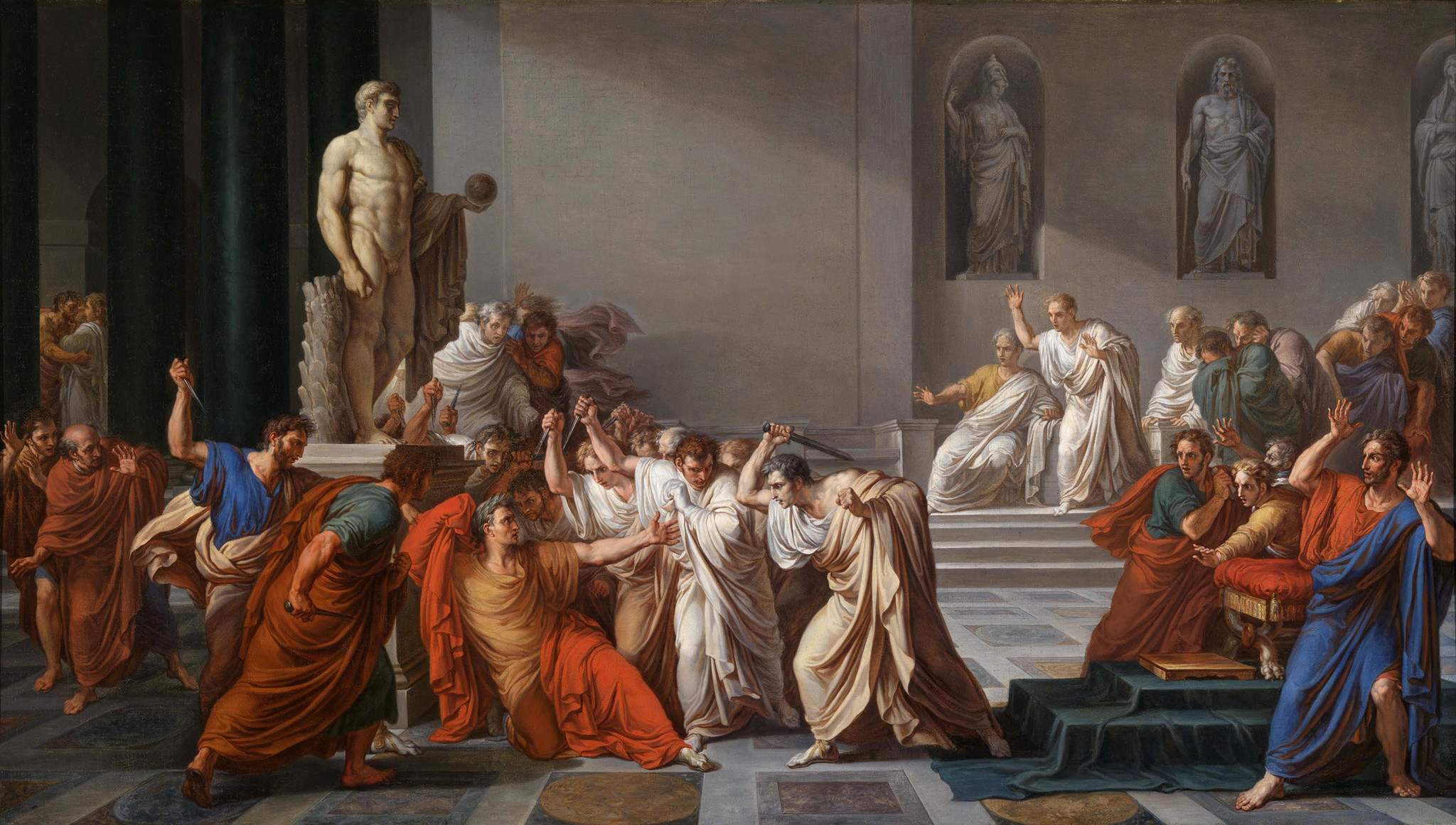
Cover image: The Death of Julius Caesar by Vincenzo Camuccini, 1806
This piece represents an independent analysis intended to provoke thoughtful consideration of complex issues. Readers are encouraged to share perspectives, counterarguments, and join the discussion in the comments or on our X account at @OccidentalForum. Your contributions help refine these ideas in a spirit of reasoned dialogue.
Comments
Loading comments...
Sign in to comment.